
One of the most vital lessons I am learning in life is the practice of trusting Allah. And yet, it feels as though what we are taught about Tawakkul and what it looks like in lived experience are vastly different. There is a difference between understanding the concept in our minds and feeling it in our bodies.
The past few years has shown me what it truly means to lean into that trust. In jest, I refer to this year as the year I become a professional ‘surfer’. Not on a literal board, but on the figurative waves that life sends – waves of uncertainty, change, disappointment, and unexpected blessings. I’ve always dreamed of riding these waves with grace, yet never realized how much courage, patience, and surrender they would require.
Attachment theory reminds us that our nervous systems are wired for safety long before logic. When we feel secure, when we know there is someone bigger holding us, we can explore, try, fall, and try again.
Tawakkul functions in the same way. It is not a promise that the waves will be calm. It is not a guarantee that we won’t wipe out. It is the assurance that we are not abandoned in the waters.
Much of our anxiety comes not from the waves themselves, but from the fear of being swallowed by them – of having nowhere safe to return to. In attachment terms, it is the fear of an unsafe return. In psychological terms it is the fear of being unseen, unheard, unheld.
Tawakkul teaches us otherwise: “Whatever happens, it will happen within the care of Allah.”
When we try to navigate life with hyper-vigilance, planning every step, holding every outcome in our hands – we are not seeking control as much as we are seeking safety. The nervous system tightens not because we want more, but because we trust less. Less in the world. Less in the process. Less in the One Who is ultimately holding us.
Tawakkul dismantles this posture. It allows us to paddle out, catch the wave, and ride it, not by forcing balance, but by leaning into the current. Effort is ours; outcomes belong elsewhere. Action is ours; surrender is ours, too. In doing so, our nervous system finds rare permission: we do not have to carry the weight alone.
What surprises me most is how relational Tawakkul feels. It resembles secure attachment not in certainty, but in return. We can stumble, panic, or wipe out and still come back. No threshold of composure is required to be received. No perfect performance of faith is necessary to remain connected. Allah does not withdraw in our dysregulation.
This is where Tawakkul moves from concept to lived experience. It is not something we recite when the seas are calm. It is something we anchor ourselves to when the waves rise. It becomes the place where we relinquish our fears, our distrust, because it has somewhere safe to land.
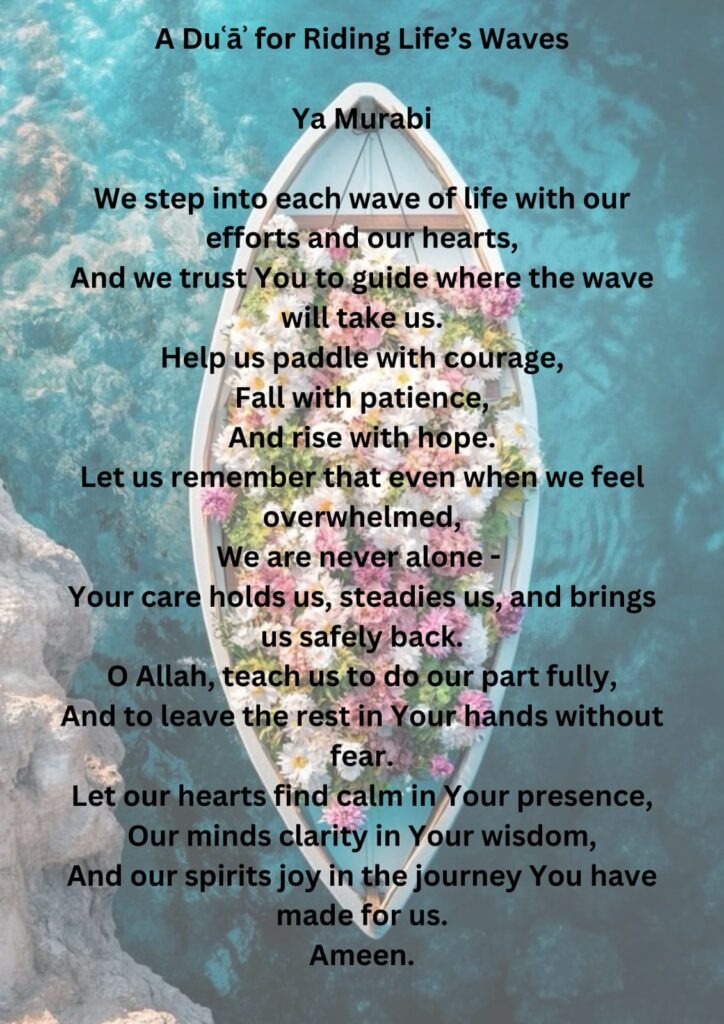
Emotionally, it changes how we relate to ourselves. We become less punitive in moments of struggle. Less alarmed by uncertainty. Less desperate to control the uncontrollable. Spiritually, it deepens our understanding of reliance – not as passivity, but as trust rooted in relationship rather than outcome.
I am learning that Tawakkul does not silence the nervous system by force. It soothes it by offering safety. It teaches us that riding the waves of life is not about never falling; it is about knowing that even in the crash, we are being held.
And perhaps this is why it is so difficult and so transformative. To practice Tawakkul is to unlearn the belief that control is what keeps us safe. It is to trust that being held by Allah is simply enough.
Not because life is predictable, but because Allah is present within it.
And that presence, I am discovering, is what finally allows our body and our heart to rest, to breathe, and to paddle out for the next wave.